I went to Pompeii yesterday. It was more than I thought it would be. Which begs the question, what did I think it would be? Before I go there let me just tell you about Italian parking. No, let me show you.
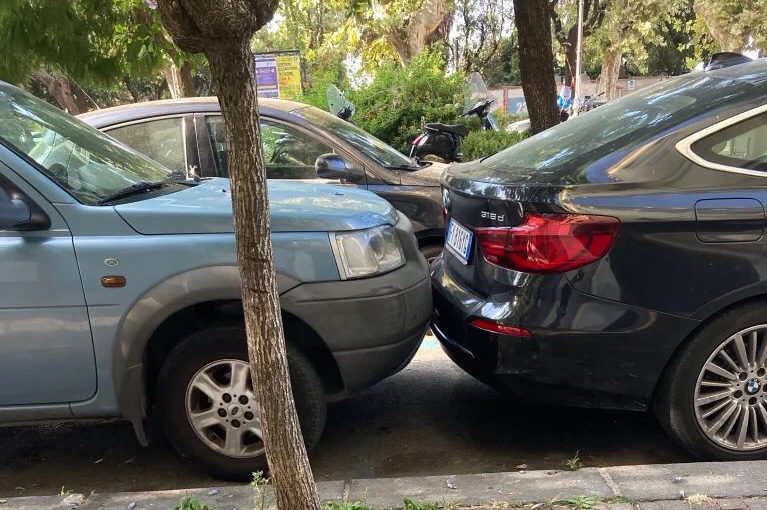
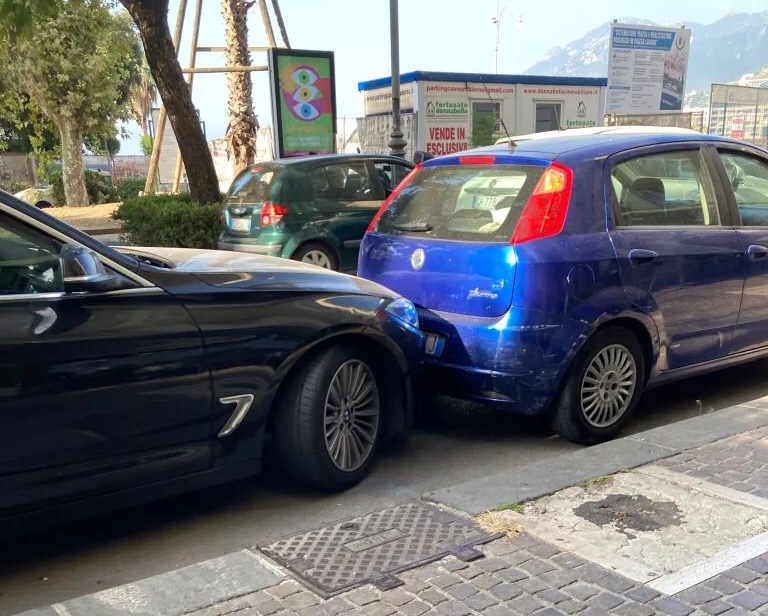
The guy driving the jag did a 178 point turn to get in there, nosing the blue car further down the road as he did so. Then walked 10 metres to get his coffee. No further comment required.
Getting to Pompeii from Salerno was easy. I went by train, fast, efficient, cheap. Oh and air conditioned, which was bliss as it has been in the 30s. When I say getting to Pompeii I mean the new town. I hadn’t thought of that. There is a modern Pompeii, so how to get to the old version? The obvious thing is to avoid the touts outside of the station right? Go to the tourist office nearby. Obvious, except…. The adviser suggests you could walk 25 minutes in the baking heat or jump a taxi for 20 euros. So you jump in a taxi. Hmmm. It’s just when you leave Pompeii from the other entrance, the one they don’t take you to, its a 5 minute walk to the station. Which makes sense, after all, why would you build a town 25 minutes from the railway?
Anyway, what did I expect from Pompeii? A ruin, the casts of the people in their final moments, murals. All that. I saw all of those, except maybe the first. Yes, Pompeii is a ruin but that gives completely the wrong picture of this place. It is – and I have thought long and hard about this word – a living town. Or, rather, you can sense the living town. There are shop fronts with advertising, the place holders on the counter and drilled holes, differently sized for different coins, change, ready to respond to a sale. There is graffiti, quite a bit of it willys. It seems the willy was a good luck charm in Rome so they painted, drew, modelled and scratched them out everywhere. Roman parents gave their children model willys as good luck tokens to take to school – don’t try this now, it’s frowned on. Willys were also potent against disease, which got me thinking. If our knowledge had not moved on, ]then the Government’s response to the recent pandemic would, presumably, be to put Willys everywhere. Which might explain Matt Hancock’s approach. Or maybe not.
So many things struck me about the place. It’s size for one. This is not a ruined abbey, or a mediaeval castle, this is a proper town with row upon row upon row of streets. Then those streets have quarters, there are two theatre spaces back to back, a large and a small, there is a huge amphitheatre for games, there is a college! The villas of the rich, as you would expect, are beautiful with colourful frescoes, gardens, fountains and running water. If you were rich in Rome you prioritised Leisure. Only the rich could be idle, the rest had to make a living, and you can see how and where in a very real way. One shop in particular struck me with its facade bearing a mural depicting the wares you could buy, its marble counter to keep perishable goods cooler and its working space.
Overall, you can feel the bustle, the people shouting and buying, mobile, active, alive. You step across well formed streets, deep between the pavements with stepping stones so you avoided the manure and rubbish that would have accumulated. It must have had a particular smell given the heat of the area. There are actual remnants of the people in some of the houses and rather bizarrely by the gift store. I found them distressing. There is enough detail to see that they were real people, you can see their clothes, you can see their shape. You can sense their pain. Personally, I don’t think they should be on show, even if its not them but casts of the space they left underneath the ash.
Go if you get the chance. You won’t regret it. Just don’t fall for the taxi thing.


Great read was thinking about an excursion to Pompei when we are on our cruise !
LikeLike